Why Sweet Corn Packaging Is One of the Most Challenging Applications in Flexible Packaging
When people think about flexible packaging, products like coffee, snacks, or pet food often come to mind. Surprisingly, one of the most technically demanding applications is something much simpler—sweet corn.
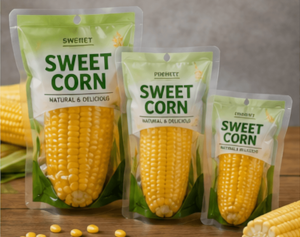
To consumers, a vacuum-packed ear of corn may look like an ordinary food package. To packaging engineers, however, it represents a complex combination of high moisture, thermal processing, mechanical stress, and shelf-life requirements. Every layer of the packaging structure plays a critical role in protecting the product from the moment it leaves the production line until it reaches the consumer’s table.
At Noupack, we have worked with customers developing packaging solutions for various corn products. One thing has become clear: not all corn requires the same level of protection, and selecting the wrong packaging structure can significantly increase product risks.
Sweet Corn and Waxy Corn: Similar Appearance, Completely Different Packaging Requirements
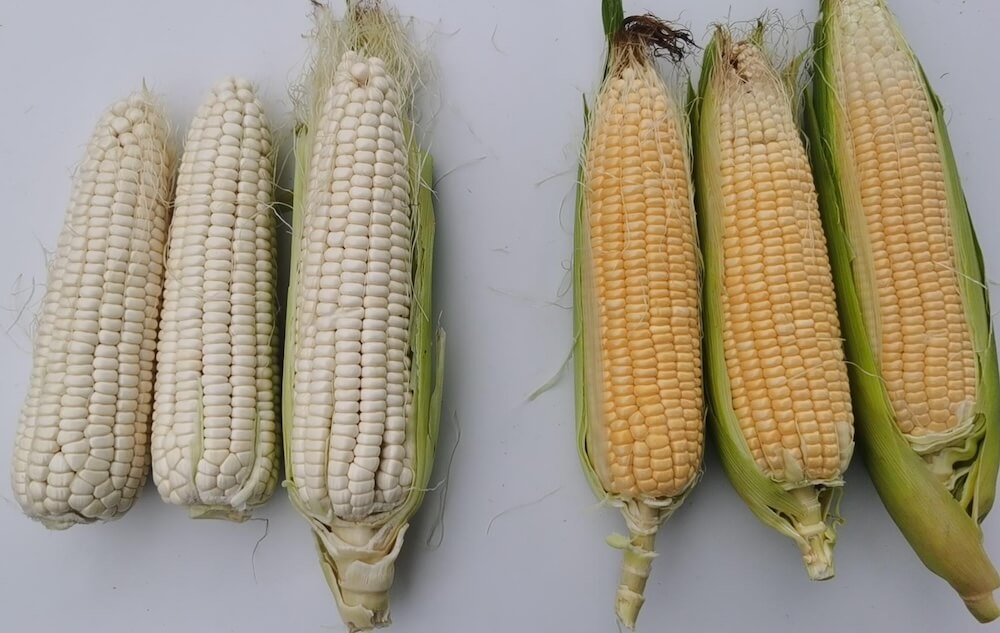
Although sweet corn and waxy (glutinous) corn are often displayed side by side in supermarkets, they behave very differently during processing and storage.
Sweet Corn
Sweet corn contains a much higher level of natural sugars and moisture. After harvesting, these sugars gradually convert into starch, making the product highly sensitive to quality changes. It is also more vulnerable to oxidation, color loss, flavor deterioration, and microbial spoilage if not processed correctly.
Most commercially packaged sweet corn undergoes:
- Vacuum packaging
- High-temperature retort sterilization (typically 121°C)
- Ambient storage
- Long-distance transportation
These conditions place exceptional demands on the packaging material.
Waxy (Glutinous) Corn
Waxy corn contains significantly more starch and less sugar. Although it is also commonly vacuum packed, it generally tolerates processing and storage better than sweet corn.
As a result, waxy corn often requires a lower level of barrier performance, allowing manufacturers to optimize packaging costs without compromising product quality.
Understanding this difference is the first step toward selecting the right flexible packaging solution.
Why Sweet Corn Is So Difficult to Package
Unlike many dry food products, sweet corn presents several technical challenges simultaneously.
High Moisture Content
Sweet corn naturally contains a large amount of water. Moisture migration inside the package must remain stable throughout storage to maintain texture and appearance.
High-Temperature Retort Processing
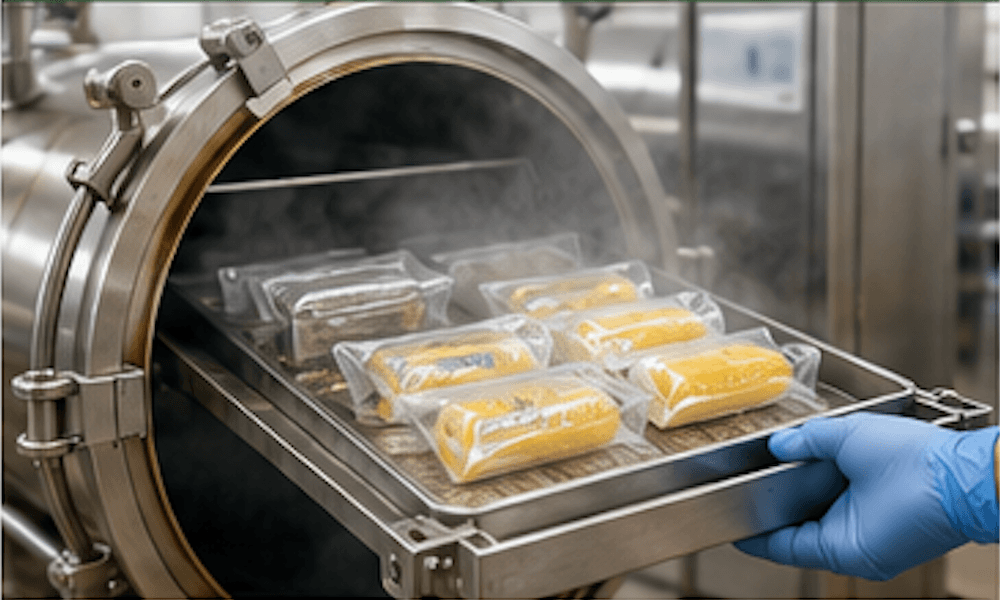
Most sweet corn is sterilized in a retort system at approximately 121°C. During this process, the packaging must withstand high temperature, pressure, and cooling cycles without losing seal integrity or experiencing delamination.
Vacuum Packaging
Vacuum packaging removes oxygen but also places continuous stress on the seals and film structure. Weak sealing performance can easily result in leakage and loss of vacuum.
Mechanical Stress During Transportation
Whole corn cobs are much more likely to puncture packaging than many other food products because of their irregular shape and relatively hard kernels. This makes puncture resistance especially important for export shipments.
Different Products Require Different Packaging Structures
There is no universal packaging structure suitable for every corn product. The right solution depends on the product type, sterilization method, distribution conditions, and shelf-life expectations.
Standard Protection
Recommended Structure
PET 12μm / VMPET 12μm / PE 70μm
Suitable for:
- Dry corn kernels
- Corn flour
- Non-retort corn products
This economical structure offers excellent printability, reliable moisture protection, and improved oxygen barrier performance compared with transparent two-layer laminates. It is widely used for dry food applications where retort resistance is not required.
Enhanced Protection
Recommended Structure
PET 12μm / AL 7μm / RCPP 70μm
Suitable for:
- Vacuum-packed waxy corn
- Medium shelf-life applications
- Conventional retort products
Adding aluminum foil dramatically improves oxygen, moisture, and light barrier performance. Combined with retort-grade CPP, this structure provides reliable sealing during sterilization while maintaining reasonable material costs.
For many vacuum-packed waxy corn products, this remains one of the most practical and cost-effective solutions.
Premium Protection
Recommended Structure
PET 12μm / AL 7μm / NY 15μm / Imported Japanese Retort CPP 70μm
Suitable for:
- Premium sweet corn
- Whole corn cobs
- Long-distance export
- High-temperature distribution
- Extended shelf-life products
This structure represents a high-performance solution for demanding retort applications.
The aluminum foil provides outstanding barrier protection against oxygen, moisture, and light. The nylon layer significantly improves puncture resistance and flex crack resistance, helping the package withstand transportation and handling. The imported Japanese retort-grade CPP delivers exceptional seal reliability after sterilization and maintains excellent mechanical performance throughout the product’s shelf life.
Why Premium Sweet Corn Often Uses Imported Retort Materials
One of the most important components in a retort pouch is the sealing layer.
While domestic retort-grade materials have improved considerably in recent years, many premium food manufacturers continue to specify imported Japanese retort-grade CPP for demanding sweet corn applications.
The reason is not simply the country of origin—it is the consistent performance.
High-quality imported retort CPP is well known for its:
- Stable sealing window
- Excellent heat resistance during retort processing
- Superior seal strength after sterilization
- Better resistance to stress cracking
- Outstanding long-term reliability in demanding supply chains
When packaging products with high commercial value and long export routes, consistency is often more important than achieving the lowest possible material cost.
Why Price Should Never Be the Only Decision Factor
One of the most common mistakes buyers make is comparing packaging quotations based only on price per kilogram or price per pouch.
Flexible packaging is not simply a commodity—it is part of the product protection system.
A lower-priced film may appear attractive initially, but if it results in seal failure, product leakage, shortened shelf life, or customer complaints, the actual cost can be many times higher than the savings achieved during procurement.
The right packaging structure should always be selected based on:
- Product characteristics
- Sterilization conditions
- Shelf-life requirements
- Transportation environment
- Distribution channels
- Brand positioning
The lowest price rarely represents the lowest total cost.
Noupack’s Perspective
At Noupack, we believe that successful flexible packaging begins with understanding the product—not simply selecting a film structure from a catalog.
Every project starts with questions:
- What is the product?
- How will it be processed?
- Will it be vacuum packed or retorted?
- How long is the desired shelf life?
- Where will it be shipped?
- What challenges will it encounter during transportation and storage?
Only after understanding these factors do we recommend the most appropriate packaging structure.
Our goal is never to overspecify materials or recommend the most expensive solution. Instead, we focus on delivering the optimal balance between product protection, manufacturing efficiency, and overall cost.
For standard products, a cost-effective laminate may be the right choice. For premium sweet corn intended for international markets, investing in higher-performance retort materials can significantly reduce packaging risks and protect brand reputation.
At Noupack, we don’t simply manufacture flexible packaging—we engineer packaging solutions that help our customers deliver safer products, longer shelf life, and greater confidence throughout the entire supply chain.
Because in food packaging, the real value is not measured by the price of the film—it is measured by how well it protects the product inside.