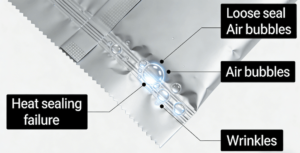
In flexible packaging, sealing is often overlooked—until it fails.
A package may appear flawless after printing and conversion, but if the seal cannot perform reliably, the entire packaging system is compromised. Leakage, contamination, and reduced shelf life are just a few of the risks associated with poor sealing performance.
What makes sealing failures particularly challenging is that they rarely stem from a single cause. More often, they are the result of complex interactions between materials, structure design, and processing conditions.
Understanding—and managing—these interactions is the key to preventing costly failures.
Sealing Is Not a Simple Step—It’s a System
At its core, sealing involves applying heat and pressure to bond materials together. In practice, however, it is a highly sensitive process influenced by multiple variables that must work in harmony.
These include:
- Sealant material properties
- Heat sealing temperature and dwell time
- Pressure uniformity
- Machine design and compatibility
- Environmental conditions during production
A deviation in any one of these factors can lead to weak seals, inconsistency, or complete failure.
At Noupack, we emphasize that sealing should never be treated as a downstream process—it must be engineered as part of the total packaging system from the very beginning.
Common Causes of Sealing Failures
- Material and Structure Mismatch
Different sealant materials—such as PE, CPP, or co-extruded functional films—each have unique sealing windows and performance characteristics.
If the selected laminate structure does not match the actual filling and sealing conditions, instability is inevitable.
For example, a structure optimized for high-speed FFS (Form-Fill-Seal) lines may underperform on lower-speed or lower-temperature equipment.
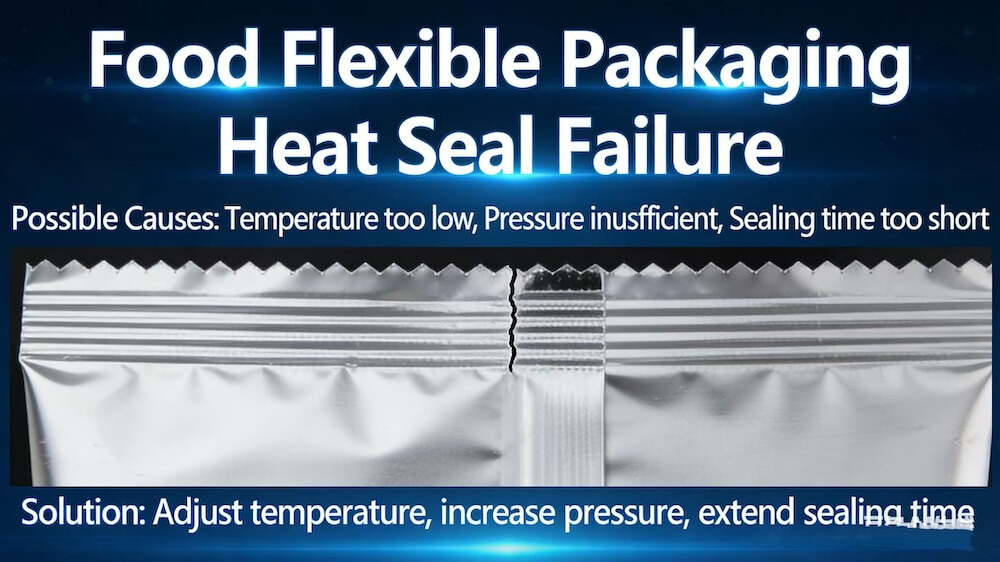
Noupack Insight:
We often see that customers focus heavily on barrier or stiffness, while overlooking sealant compatibility with their actual machinery. In reality, sealant selection should be machine-driven, not just application-driven.
- Incorrect Sealing Temperature
Each sealant material operates within a defined temperature range.
- Too low → seals may appear closed but lack strength (false seals)
- Too high → risk of deformation, burn-through, or layer degradation
Temperature mismatch is one of the most common—and underestimated—causes of sealing issues, especially when materials are transferred between different production lines.
Noupack Insight:
We recommend defining not just a “target temperature,” but a sealing window range, giving production teams flexibility while maintaining performance stability.
- Machine Variability and Process Conditions
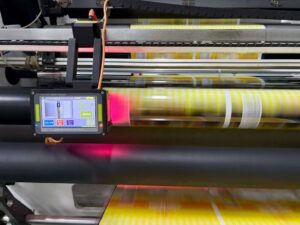
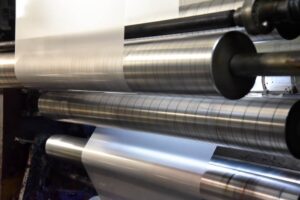
Even with the correct structure, sealing performance depends heavily on equipment.
Variations in:
- Heating element design
- Pressure distribution
- Line speed and dwell time
can significantly impact seal integrity.
A material that performs well on one machine may fail on another if process parameters are not properly aligned.
Noupack Insight:
In our projects, we frequently conduct machine-specific validation trials, because lab results alone cannot fully replicate real production dynamics.
- Surface Contamination
Effective sealing requires clean contact surfaces. In real-world production, contamination is often unavoidable.
Common contaminants include:
- Powders
- Oils or greases
- Product residues
These can interfere with heat transfer and bonding, leading to localized seal failures—often undetectable until transportation or storage.
Noupack Insight:
For challenging applications, we may recommend anti-contamination sealant layers or modified structures designed to tolerate light contamination without compromising seal integrity.
Case Study: When Sealing Fails on the Production Line
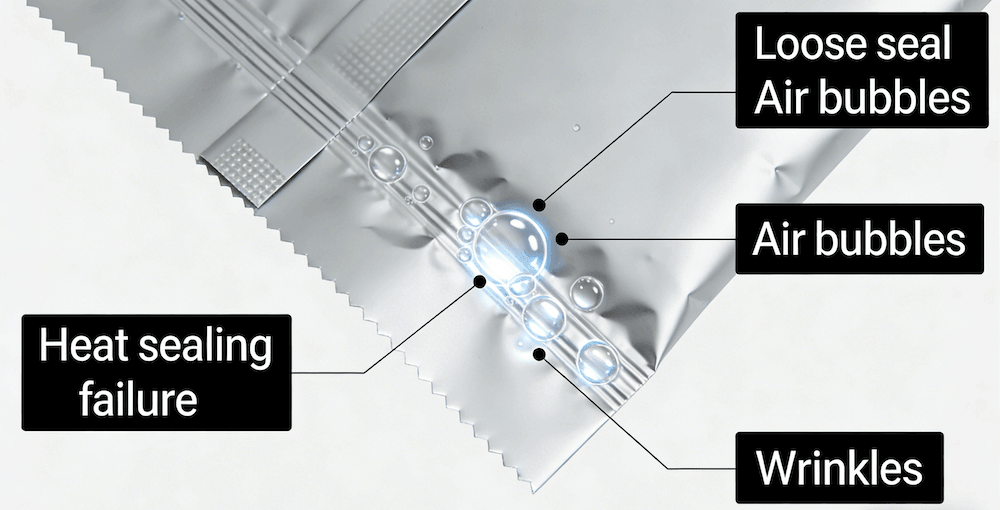
In one real-world case, a customer sourced rollstock film that passed all initial inspections. However, during actual production, the film failed to seal properly.
At first, the issue appeared to be a material defect.
After detailed analysis, the root cause was identified:
the sealing temperature on the customer’s equipment was below the optimal range required for the selected sealant structure.
Rather than immediately redesigning the material, our technical team collaborated with the customer to adjust machine parameters—specifically temperature and dwell time.
Once optimized, the same material achieved stable and reliable sealing performance.
Key takeaway:
Sealing failures are often not purely material problems—they are system compatibility issues.
Why Sampling Success Doesn’t Guarantee Production Stability
A common misconception is that successful sampling guarantees smooth mass production.
In reality, sampling conditions are often very different from actual production environments. Differences in:
- Machine type
- Production speed
- Operating conditions
can significantly affect sealing behavior.
Noupack Insight:
We strongly advocate for on-line testing under real production conditions before finalizing material specifications. This reduces risk and avoids costly adjustments after scale-up.
How to Prevent Sealing Failures
Preventing sealing issues requires an integrated, system-level approach.
Best practices include:
- Selecting materials based on actual machine conditions
- Defining clear and realistic sealing windows
- Testing on customer equipment—not just in controlled lab environments
- Maintaining seal area cleanliness during filling
- Ensuring early collaboration between material suppliers and technical teams
At Noupack, we position ourselves not just as a material supplier, but as a technical partner—working closely with customers to align structure design with real-world production conditions.
Sealing Is a System Responsibility
Sealing performance is not determined by materials alone, nor by machinery alone. It is the result of how structure design, process parameters, and application environments work together.
When these elements are aligned, sealing becomes stable, predictable, and repeatable.
When they are not, even the most advanced packaging structures can fail.
For brands and buyers, the goal is not simply to achieve a seal—but to ensure consistent sealing performance across production, logistics, and end use.
That consistency is what ultimately protects both the product—and the brand.